
November 29, 2025
Ethics
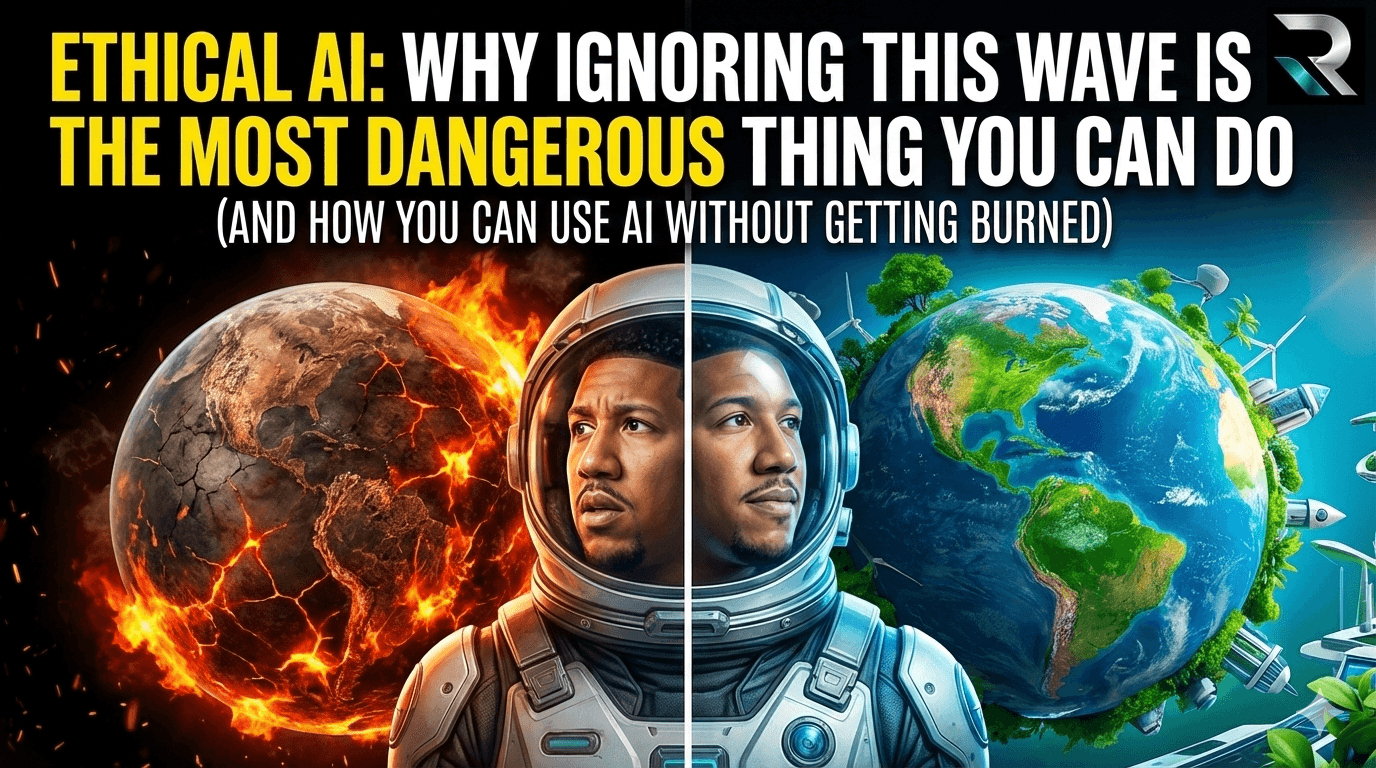
Ethical AI: Why Ignoring This Wave Is the Most Dangerous Thing You Can Do (And How You can use AI without getting burned)
AI is not coming someday. It is here. It is in our phones, our apps, our credit checks, our social feeds and in the background of decisions that shape real lives. Too many people treat it like magic. That mindset is the real danger.
Avoiding AI does not keep you safe. It gives more control to companies and institutions that are not always thinking about your best interests.
This is not fear. This is awareness and responsibility. The tools and the power are already active. If we do not hold companies and institutions accountable, regular people lose.
1. AI is Already Making Decisions About Us
AI already plays a part in decisions like:
Who gets a loan and what rate they receive
Whether your resume gets seen
What news or ads show up in your feed
Which applicants get selected for jobs
How your insurance gets priced
How police identify “suspicious” people
Whether students get into certain programs
Most of the time you never even know AI was involved. That lack of transparency is exactly why ethics matter.
When decision making happens in the dark, accountability disappears.
2. AI Is Not Neutral
AI does not erase bias. It learns from the world we give it. If the world is unequal, the model becomes unequal in ways that scale.
Real examples:
A well known study from MIT Media Lab found that facial recognition errors were under 1 percent for light skinned men. For dark skinned women, error rates reached more than 34 percent.
Several Black Americans have been wrongfully arrested in the last few years because face recognition systems misidentified them.
In healthcare, one hospital algorithm used “past spending” as a shortcut for “who needs care.” Because Black patients historically had less access to healthcare, the system wrongly predicted they needed less support.
These are not small problems. This is how bias becomes automated and invisible.
3. AI Has a Real Environmental Cost
AI feels digital, but it runs on physical servers, cooling systems, electricity, and water.
Some facts:
Training GPT-3 used more than one thousand megawatt hours of electricity and released over five hundred metric tons of carbon dioxide.
Large models need water to cool data centers. That water often comes from freshwater sources already under pressure.
As models get bigger, emissions grow with them. Once they are deployed into search engines, personal devices, and appliances, the total footprint multiplies fast.
When millions of people use AI every day, these costs stack up in a real way.
4. Creators and Everyday People Are Getting Taken Advantage Of
AI models learn from massive collections of human work. That includes artwork, music, writing, and photography. Much of this is scraped from the internet without permission.
A few points to understand:
Many models were trained on huge datasets built from images and writing that creators never agreed to share.
Tools like “Have I Been Trained” let artists see how much of their work ended up inside these training sets.
This has already led to lawsuits from artists who found their entire portfolios inside these datasets.
Consent is not just a creative issue. Today it is art. Tomorrow it might be your voice recordings, your social content, or your child’s images.
If companies do not ask, do not disclose, and do not compensate, the imbalance only grows.
5. Real Solutions People Can Use Right Now
You do not need to be a programmer. You only need to be intentional.
A. Learn the basics
Spend a few minutes each day using AI tools. Ask questions. Experiment. Understanding how AI works gives you agency.
B. Ask three key questions every time you use AI
Where did this model get its data
How is my data being used
Is there a more ethical version of this tool
If a company cannot answer those questions clearly, that is a warning sign.
C. Support companies that choose transparency
Look for tools that list their training sources or allow creators to opt out. Support models with published environmental impact reports. These choices matter.
D. Push for guardrails
AI will not disappear. We can still demand rules that protect people. These include:
Mandatory disclosure when AI is part of a decision
Consent based training datasets
Independent audits for bias
Environmental impact reporting
Restrictions on high risk uses like policing
This is not anti technology. It is pro humanity.
E. Use AI for empowerment instead of replacement
Use AI to lift your output, your creativity, your skill set. People who engage with AI intelligently will benefit. People who avoid it will fall behind.
6. Why This Matters Right Now
AI adoption is accelerating faster than government, regulation, or public understanding. Companies move quickly. Our institutions move slowly. If we do not pay attention, the systems that shape our lives will be built without our presence at the table.
Most people still believe AI is someone else’s problem. That was never true. But today it is even more urgent to face it directly.
7. The Bottom Line
AI will shape our economy, our culture, our freedoms, our relationships, our information streams, and even the future our kids grow up in.
The question is simple. Will we be passive or will we participate
Ignoring AI does not protect you. Awareness does. Curiosity does. Asking questions does. Demanding transparency does.
The future is still being built. It is not set in stone. But only the people who engage will have a say in what that future becomes.
Learn. Use. Question. Demand. Vote with your attention and your choices.
If you do not speak up, someone else will do the speaking for you.