
November 26, 2025
Article
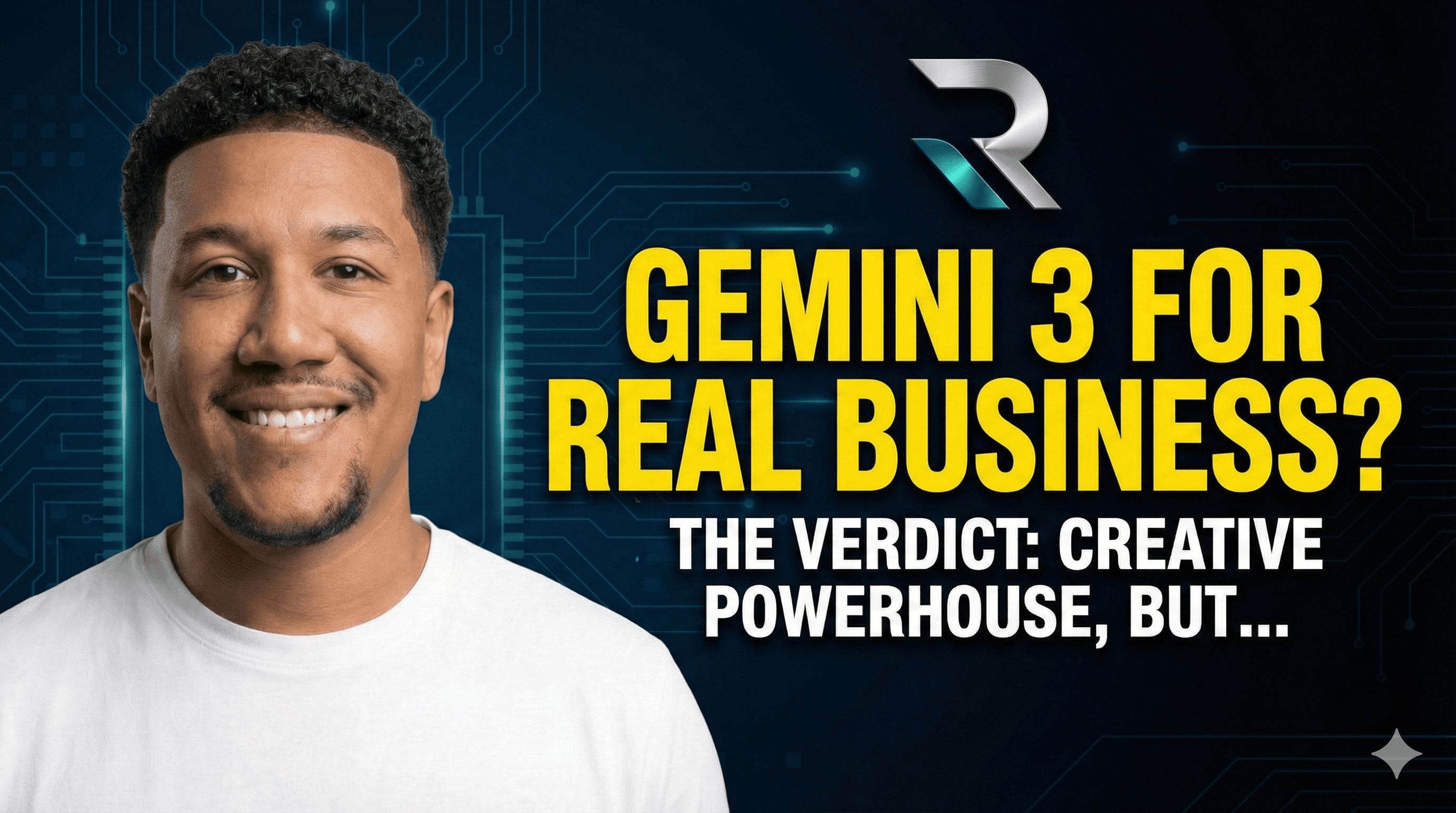
Gemini 3 vs Reality: What It Gets Right, What It Gets Wrong, and How Rezzivo AI Actually Uses It
The internet is calling Gemini 3 “the best model in the world.”
Benchmarks are exploding. Demo videos are everywhere. Everyone’s posting wild 3D games, code generators, dashboards, and AI-built UI demos.
At Rezzivo AI, we don’t judge models by hype.
We judge them by one thing.
Do they hold up inside real business automations?
We run AI agents for realtors, wholesalers, service businesses, and small teams. We use these models to write code, build workflows, handle follow-ups, generate content, analyze conversations, and make decisions. If a model isn’t stable, predictable, and reliable, we feel it fast.
Here’s what Gemini 3 gets right, where it falls short, and whether it replaces the current tools inside your business stack.
The Short Version
Gemini 3 is incredible for:
Creative coding
UI, game-like demos, interactive widgets
Visual generation
On-the-fly design work
Massive context tasks
But it struggles with:
Tool calling
Staying adaptable inside long workflows
Not getting stuck on one interpretation of a task
Verdict:
A creative powerhouse. Not yet a dependable “core agent brain” for business automations.
What Gemini 3 Actually Does Well
1. Creative Code and UI Generation Is On Another Level
This is where Gemini 3 is a monster.
We’ve seen it build:
Fully interactive browser games
3D demos with lighting, physics, and sound
Dashboard components with animations
Clean, organized diffs that plug right into codebases
If you need an AI to build visuals, interfaces, front-end tools, prototypes, or demos, Gemini 3 is one of the best out right now.
This helps us at Rezzivo AI rapidly prototype:
Internal dashboards
Lead routing interfaces
Lightweight client-facing widgets
Real estate agent tools
Custom visual automations
Speed is insane. Quality is high.
2. It Handles Big Context Smoothly
Gemini 3 supports:
1,000,000-token context
65,000-token outputs
A fresh January 2025 cutoff
For long strategy documents, structured plans, codebases, or entire workflow audits, this is extremely useful. When we do big architecture planning for clients, Gemini 3 makes the exploration phase far more efficient.
3. The New Image Model Is Quietly a Nuclear Bomb
Nano Banana Pro (Gemini’s new image model) is arguably more important than Gemini 3 itself.
It nails:
Charts
Diagrams
Infographics
Social content frameworks
Website hero images
Editable templates
It’s clean, legible, and shockingly practical.
We’re already using it inside client projects to generate:
GMB posts
Instagram graphics
Email visuals
Product mockups
Real estate marketing assets
It saves hours.
Where Gemini 3 Still Struggles
1. It “Locks In” To the Wrong Path and Refuses To Let Go
This is the big one.
During long sessions, Gemini 3 will:
Stick to a certain interpretation
Ignore your correction
Repeat the same wrong attempt
Try to force a broken idea through
In automation work, that’s dangerous.
If your AI agent is supposed to:
Pull leads
Analyze a response
Update a CRM
Send follow-ups
Make decisions based on keywords
…and it locks onto the wrong logic pattern, you end up with inconsistent behavior.
That’s why we don’t use Gemini 3 as the primary agent model inside Rezzivo systems.
2. Tool Calling Isn’t Top Tier
Gemini 3 improved over 2.5, but it’s still not as strong as:
Claude Haiku
Grok 4.1
These two remain the champions for:
Multi-step research
Calling multiple tools correctly
Maintaining state across the entire chain
Executing workflows without hallucinating
Gemini 3 has power, but not yet the discipline needed for reliable business automations.
How We Use Gemini 3 Inside Rezzivo AI
Here’s our internal stack right now.
We use Gemini 3 for:
Coding and rapid prototyping
UI generation
Visual assets
Big context planning
Creative interactive demos
We do NOT use Gemini 3 for:
Client-facing automations
Lead qualification agents
CRM sync workflows
Scheduling agents
Sentiment-driven responders
Multi-step reasoning chains
Those require models that:
Stay on track
Follow tools precisely
Adapt mid-stream
Don’t get tunnel vision
That’s where Claude Haiku, Grok, and GPT-5.1 Thinking shine.
Our job is to choose the right model for the right task. Not force one into every role.
So… Is Gemini 3 the Best Model?
It depends on what you’re measuring.
If you want creative code and visuals:
Gemini 3 is the new king.
If you want an AI agent to run your business workflow:
It’s not there yet.
If you want reliable tool calling:
Haiku and Grok still dominate.
If you want balanced reasoning:
GPT-5.1 and Claude Opus still feel more grounded.
If you want presentations, infographics, and graphics:
Nano Banana Pro is insane.
The right answer isn’t “use Gemini 3.”
The right answer is use the right tool at the right layer of your automation stack.
That’s what we do for every Rezzivo client.
Final Thoughts
Gemini 3 is powerful.
Incredible even.
But it’s not perfect, and you shouldn’t rebuild your entire workflow around one model because Twitter says it’s the best.
At Rezzivo AI, we test every model in real environments, not demos. We pick the model that gives you:
Reliable execution
Stable performance
Lowest error rates
Highest throughput
Best long-term scalability
Gemini 3 is an amazing addition to the toolkit.
It’s not the only tool in the kit.
If you want to know exactly which AI model is right for your automations, that’s the work we do every day.